
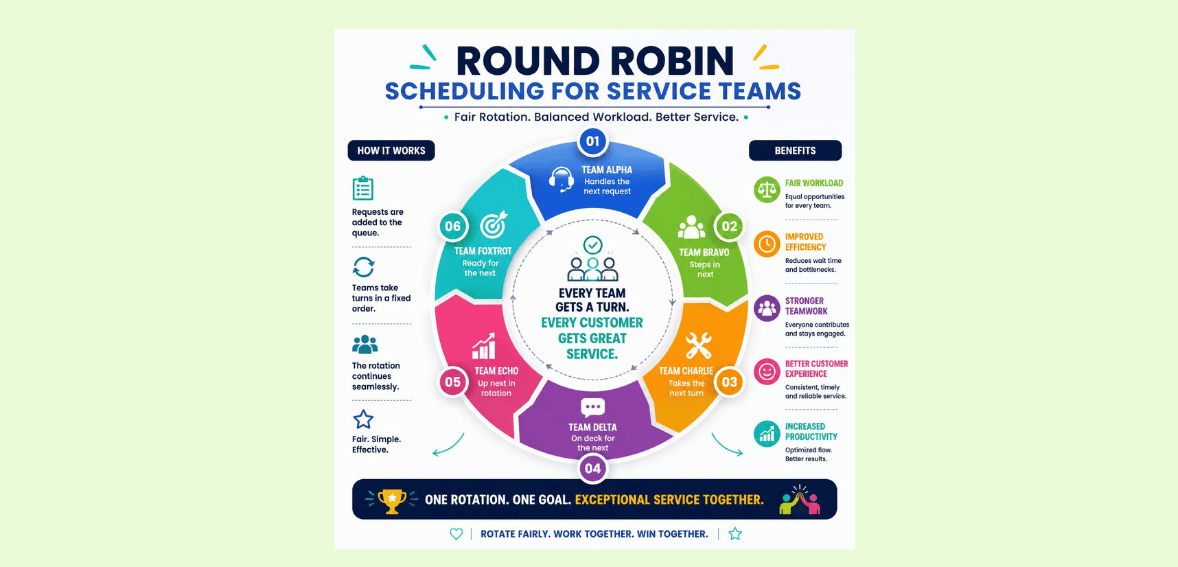
Picture this: ten support tickets coming into your system before 9am. One support agent picks up five tickets. Another picks up none. By lunch, half your support team is swamped while the other half is just sitting waiting. Does this sound familiar? This is the exact problem that round robin scheduling is designed to solve. Round robin scheduling takes over the burden of deciding “who handles this next” and automates a fair rotation system.
For service teams that are managing the juggling act of appointments, leads and support requests, that rotation equates to faster response times, increased customer satisfaction and considerably decreased employee burnout. This guide will show you what round robin scheduling is, how it operates and how to implement it so your team is operating efficiently, starting with day one.
What Is Round Robin Scheduling?
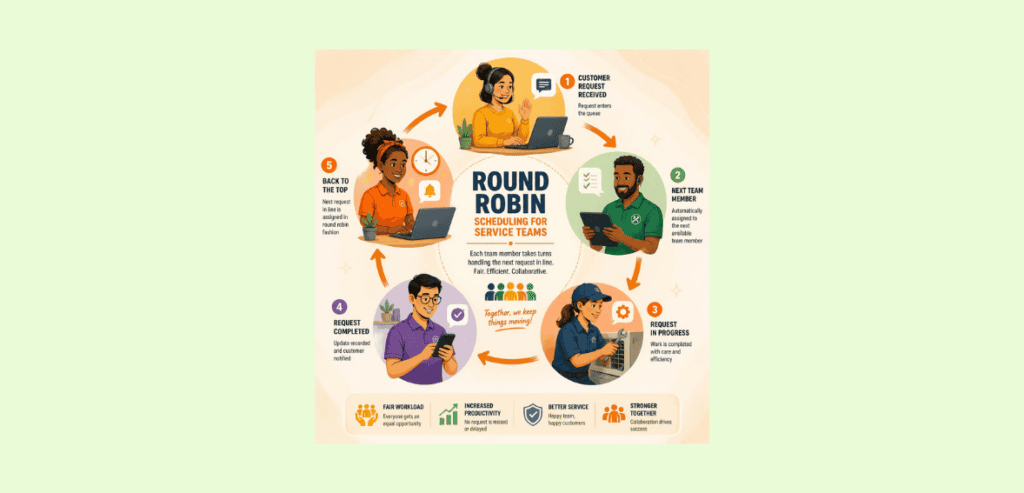
Round robin scheduling is a method for assigning tasks, appointments, or customers to team members in a fixed, cyclic order. Each person takes a turn. Then the rotation loops back to the start. Nobody gets skipped, and nobody gets stuck with an unfair share.
The main principle is achieving fairness that is based on consistency. Rather than leaving it to a manager to pick the best person to carry out each new task, the system adopts a set order. This eliminates favoritism and reduces the daily back-and-forth of manual assignment.
Support/service teams greatly appreciate this system because the work they do is often interchangeable. One member can handle a support chat, a booking, or a discovery call which another member can also do. In such a case, the use of a round robin system allows for the scheduling and the work to continue without a single person having to step forward to manage the flow of work. This system creates a great improvement to both efficiency and work satisfaction.
How Round Robin Scheduling Works
The term comes from computer science. In operating systems, round robin is a preemptive CPU scheduling algorithm that gives each process an equal slice of processor time, called a time quantum. When one process uses up its slice, it moves to the back of the queue and the next one runs. The cycle repeats until every job is done.
Unlike its computer-science counterpart, team-based round robin scheduling operates without that millisecond precision. To understand the round robin scheduling approach, consider a rotating vertical list of team members. Each time a booking or ticket comes in, the next available team member gets the booking. The team member is then moved to the back of the line. When the list is completed, the system starts at the top of the list again.
Modern-day scheduling systems have built on the past and introduced intelligent features. Current scheduling systems check someone’s calendar before assigning a booking. If a scheduled team member is unavailable, the system will assign the booking to the next available team member. Current systems also provide analytics on the number of bookings team members have been assigned. This prevents one team member from being booked significantly more than the rest of the team members. Overall, booking assignments appear much more fair when using modern scheduling systems.
Why Service Teams Rely on Round Robin Scheduling
The biggest payoff is speed. Research on sales response times shows that most buyers expect a reply within minutes, and the first company to respond often wins the deal. Round robin scheduling routes each request to an open team member instantly, so nobody sits waiting while a manager decides who’s up next.
Balanced workloads are the second major win. When assignment rotates equally, no one has to carry the team while everyone else sits idle. That distribution of work reduces stress and burnout, and leads to an even performance across the team. Less of an uneven workload keeps the team engaged over time and reduces turnover.
There is a fairness benefit that can easily be missed. With the order being automated and fixed, there can be no favoritism. No one is more privileged than the rest to receive the best leads or the best appointments. With that order automated, complaints from employees are reduced.
Round robin scheduling is a great way to save time for management. Assignments being automated reduces the number of spreadsheets, reduces time-wasting questions, and reduces the workload. Management can finally focus on coaching and strategy, rather than sorting tasks every morning.
Round Robin Scheduling vs Weighted Round Robin
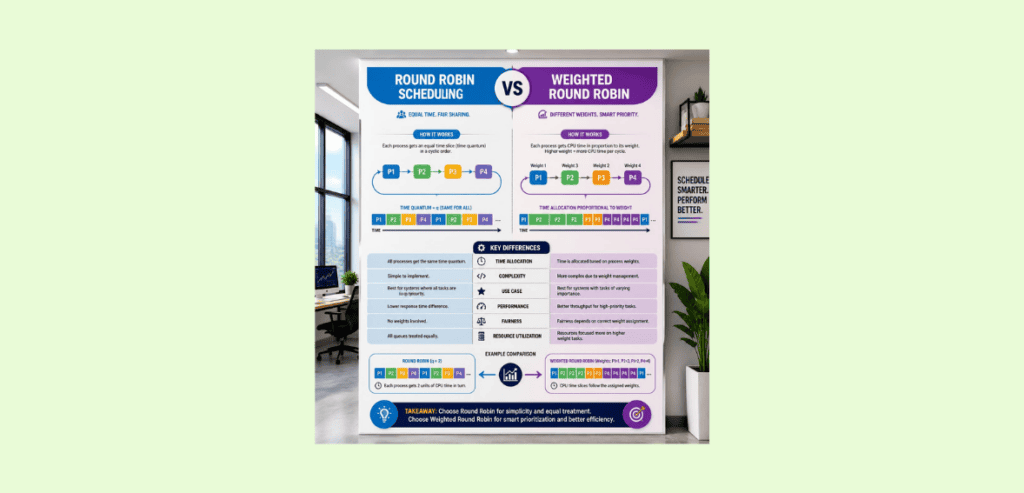
Standard round robin scheduling treats every team member equally. Each person gets the same turn in the same order. That works beautifully when everyone has similar skills, capacity, and availability.
However, typical teams aren’t the same across the board. A senior representative may need to take on and manage more sophisticated accounts, while a junior employee may take on accounts of a simpler nature. Here, you’ll want to use what’s called a weighted round robin. This method assigns a “weight,” or value, to each team member based on how much account work they should be responsible for. The employee with the greater value will receive more work, while the employee with less value will receive less work.
The weighted round robin method was initially created as a more advanced algorithm for computing and optimizing based on the need of specific processes to receive different amounts of time from the CPU (central processing unit). The same principle can neatly be applied to managing resources. You can weight assignments based on the seniority of the staff member, their performance, the time they have worked, or simply their capacity to take on more work.
When trying to determine what method should be used, you’ll need to consider the team you’re working with. When team members are more or less the same with the same skill set, a round robin method will work just fine. When there are great differences in skill set and availability, a weighted method should be applied to keep things fair.
Real-World Use Cases Across Service Teams
Customer support is the most common home for round robin scheduling. Incoming tickets and chats get distributed evenly across agents, which prevents overload and shortens response times. It also works well for rotating shift coverage, especially for the late-night or weekend slots most people would rather avoid.
Sales teams use round robin scheduling to distribute incoming leads. Since most sales reps are capable of conducting a discovery call or consultation, the lead gets distributed evenly through the rotation, giving each sales rep an equal opportunity to close the deal. Appointment-based businesses use a similar strategy to bookings. They rotate available time slots among staff to ensure that customers always have a variety of options.
Healthcare and professional services use round robin scheduling as well. Clinics use this system to evenly distribute patients among providers in order to minimize patient wait time and balance the provider’s caseload. This system is also used by customer success and onboarding teams in order to evenly distribute new customer accounts. Round robin scheduling is used anywhere work can be done in the same manner and time is a key factor.
Top Round Robin Scheduling Tools for Service Teams
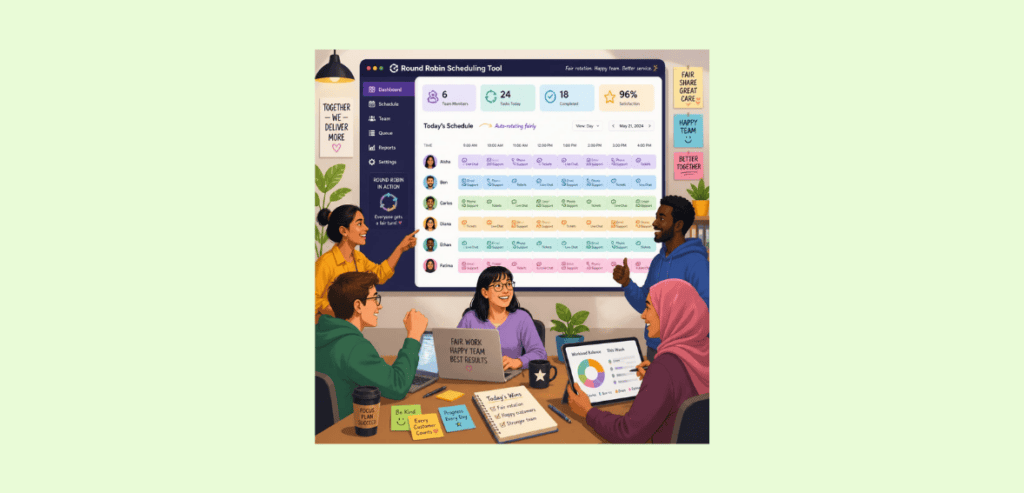
You don’t need to build a rotation by hand. Several platforms handle round robin scheduling automatically, checking calendars and assigning meetings behind the scenes.
Calendly
One of the most popular scheduling platforms out there is Calendly, and among sales and support teams, its Round Robin event type is the most popular. When customers select a time, Calendly books the meeting and quietly assigns it to an available team member. This is based on the rules set by the users. It can share meetings equally, assign the next meeting to the team member who has the longest time since last having a meeting, or based on the priority rules set. It also has a feature to cap booking volume. Each team member can also be assigned a daily or weekly limit to protect against burnout.
HubSpot
HubSpot includes a built-in meeting scheduler with round robin functionality. This is a great feature for teams that have integrated a CRM system. To set this up, simply create a round robin meeting page. Your prospect will be able to book a time that works for at least one of the connected calendars. HubSpot will assign the meeting, and if you set up the business contact owner logic, the meeting will be assigned to the prospect’s sales rep. Because this feature is integrated into the CRM, meeting data will sync to the contact and their respective sales opportunity in the CRM.
Cal.com
Cal.com provides teams with a highly configurable open-source scheduling tool complete with a flexible round robin booking system. Their system fairly balances bookings and distributes them to the available hosts. Given Cal.com’s open-source configuration, teams can choose to fully control, modify, or host their own instance of the application. Cal.com can be used for the same common use cases in scheduling for sales and support calls, and provides additional possibilities in customizing the application.
Best Practices for Setting Up Round Robin Scheduling
Great habits separate smooth rotations from messy ones. Start by syncing team member calendars. Add the blocking of personal time. Now the system cannot offer time that isn’t truly available. It also will never double book.
Consistent meeting type is key. Any meeting host should feel equally prepared and able to deliver the same meeting. If one sales rep has a completely different meeting than another, it stops feeling seamless to the customer. Prep time is equally important. Add margin time and meeting notice time to ensure everyone has time to prepare.
Booking limits help avoid meeting overload, but it is important to regularly check meeting saturation of the system. Avoid consistent underbooked and overbooked meetings in the system by regularly adjusting the booking pool. Finally, integrate your booking system with your CRM to ensure auto-logging of assignments. With accurate records, you can easily report and hand off assignments. With these few habits, almost all of your round robin booking can take care of itself.
Conclusion
Round robin scheduling turns a daily headache into a background process. Instead of arguing over who takes the next lead or letting tickets pile up unevenly, your team gets a fair, automatic rotation that keeps work flowing. The payoffs are real: faster response times, balanced workloads, less burnout, and less manual busywork for managers. Whether you choose the simple equal rotation or a weighted version that reflects your team’s differences, the goal is the same. Give every customer a quick response and every team member a fair share. Start small, sync your calendars, pick a tool that fits your stack, and let the rotation do the heavy lifting.
Frequently Asked Questions
What is round robin scheduling in simple terms?
It’s a way of assigning tasks or appointments to team members in a set, repeating order. Each person takes a turn, then the cycle loops back to the start. This keeps the workload fair and removes the need to decide manually who handles each new request.
Is round robin scheduling only for sales teams?
Not at all. While sales teams use it heavily for lead distribution, round robin scheduling works just as well for customer support, appointment booking, healthcare scheduling, and customer success. Any team whose work is interchangeable across members can benefit from it.
What’s the difference between round robin and weighted round robin?
Standard round robin gives every team member an equal turn. Weighted round robin assigns different shares based on factors like seniority, capacity, or availability. Use plain round robin when roles are similar, and weighted round robin when workloads should reflect each person’s role or bandwidth.
Can round robin scheduling prevent employee burnout?
Yes, when it’s set up well. By distributing work evenly and letting you cap how many assignments each person receives, round robin scheduling stops any single team member from carrying too much. That balanced load is one of its most valuable long-term benefits.