
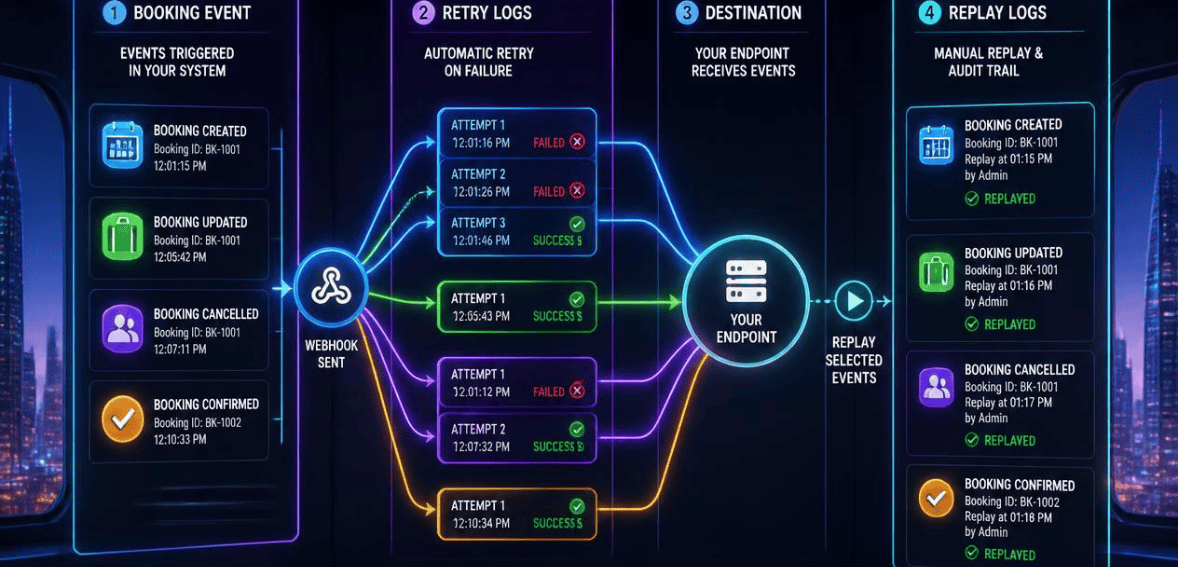
A guest books a table for eight. Your calendar never updates. The payment clears, but the confirmation email never sends. The customer shows up. The table is gone. Somewhere in the middle of all that, a webhook quietly failed, and nobody noticed.
This is the hidden fragility almost every scheduling product has. Scheduling events happen through webhooks between different systems. When one delivery fails, the whole booking can become unsynchronized. This is why a good booking webhook retry strategy, coupled with clean replay logs, is not a nice-to-have. It is the difference between a booking platform that people trust and one that people avoid.
This guide explains how retries and replay logs work for booking events. It also contains a comparison of the tools that can be purchased versus the tools that can be built.
What Are Webhook Retry and Replay Logs?
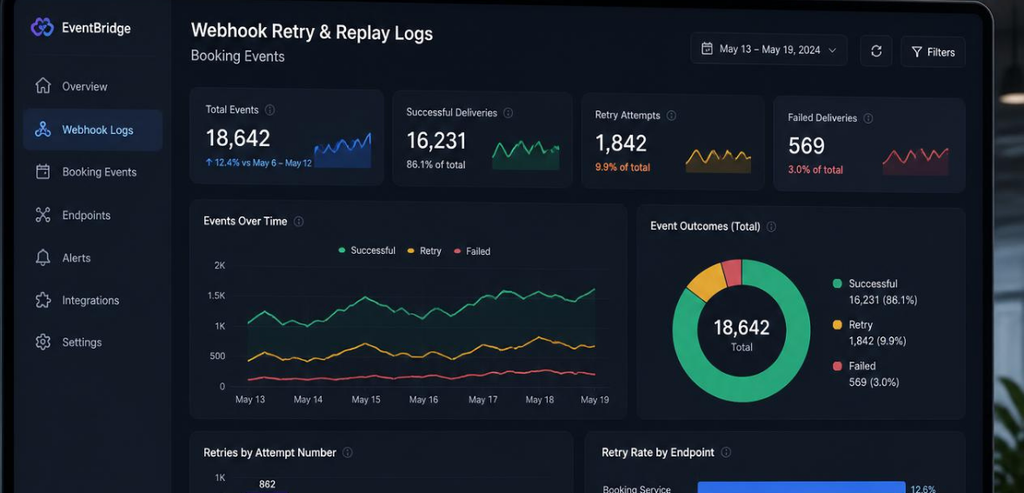
A webhook is almost like a notification. One system sends information about an event as a webhook when something happens. A booking is created, a reservation is canceled, a payment is made, etc. The other system listens and responds.
The delivery of webhooks isn’t guaranteed, and there are many reasons why webhooks can disappear. The message gets “lost” when a request times out, when there is congestion on the network, or even when the receiving system gives a 500 error.
That “something” that catches the event that is lost is your retry and replay infrastructure. A retry is an automatic request to resend the message. The sending system sends the message again after the delivery fails. A replay log is a log of all messages and all the attempts to deliver the message. The replay log allows you to replay a given message after a system failure, at a later time, and under your control.
How Retry Differs From Replay
There seems to be a lot of confusion between these two concepts. To clarify, webhook retries are automatic and happen without you having to do anything. Webhook delivery systems have retry rules associated with each webhook that allow the system to automatically retry the delivery of the webhook at scheduled retry intervals.
A replay, on the other hand, is deliberate and requires you to take action. This is often initiated by a customer support agent or scheduled recovery job. Replay events are sent after a fix for an outage, for example. You would select a group of events that had failed to be delivered and initiate their delivery.
Like webhook retries, replays send the same event with the same data. The distinction is in the intent. Retries occur spontaneously. Replays happen as a follow-up to a customer support case. Both are necessary for a strong booking pipeline.
Why Booking Events Break Without a Retry Strategy
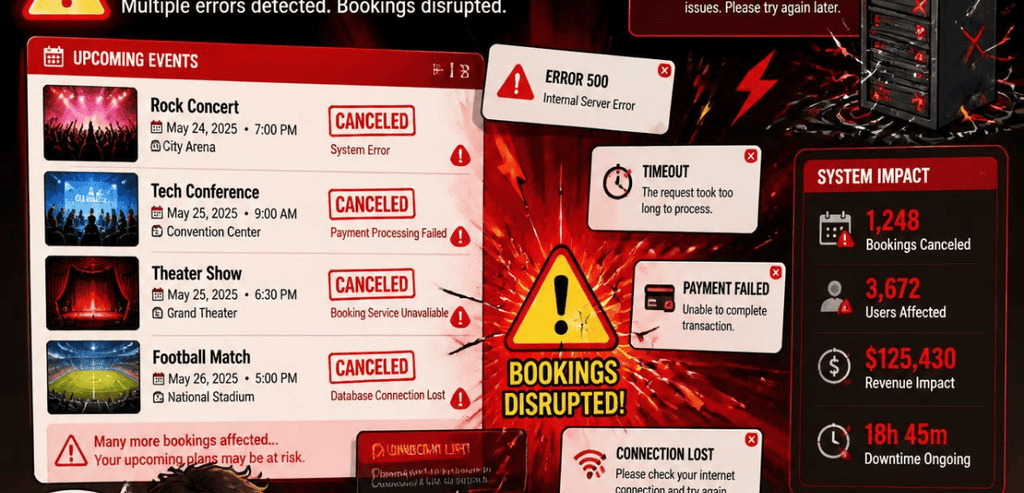
Booking events carry real money and real commitments. That raises the stakes far above a typical data sync.
What happens with a booking-created event? A booking is confirmed, a slot is reserved, a room, chair, or seat is reserved, a payment is made, the customer receives a confirmation, and a staff member receives a notification. If a confirmation fails, everything downstream stalls.
Many integrations with webhooks fail silently. An error is returned to the sender, and the sender tries to resend the request a couple of times before giving up. Nothing happens in your system to process the event, and no alert is triggered. The booking information gets lost between the two communication systems.
Most booking systems also do not necessarily guarantee the order of events. A booking might even occur after it gets canceled. A booking webhook system must be built to handle such cases and not just to think about the typical steps of a booking process.
How Booking Webhook Retry Works
A good retry system is not just “try again.” It is a set of rules that recover from failure without making things worse.
Exponential Backoff and Jitter
The pattern is called exponential backoff, which is when the sender waits a certain amount of time to retry the delivery after a failure. Each retry waits for a longer amount of time than the last. A common pattern is to double the amount of time each time. One second, then two, then four, then eight, etc.
There is a reason this is important. Hammering a struggling server with instant retries can cause the server to completely crash. Backoff allows the destination to compensate.
There are some exceptions. If a large number of events occurred and failed at the same time and then retried in a strictly backoff pattern, they can collectively overload the server when it returns. This is the “thundering herd” problem. The solution for this is to add jitter. Jitter adds randomness to each attempt to retry, in order to avoid overload.
Dead Letter Queues and Retention
No event should retry forever. You set a cap. Most systems attempt delivery five to ten times over roughly three days, then stop.
When an event fails, the event processing engine moves that event to a DLQ or dead letter queue. The DLQ is like a waiting area for events that could not be delivered. Everything is retained. The event is stored in the DLQ with its complete record, allowing an engineer to look through the events to understand the full context and the reason the event failed to be processed. Likewise, a retention policy is needed for a DLQ.
It’s expected that the entries in a DLQ will be retained for a short period of time and will be cleared after a certain amount of time, such as after seven days, or cleared upon request. This is why replay logs are important, because a DLQ full of failed bookings provides no utility unless the events can be replayed after the bug has been removed.
Replay Logs: Your Safety Net for Booking Events
Retries handle the moment of failure. Replay logs handle everything after.
Replay logs include each event, its status, the attempts made to deliver it, the attempt number, time scheduled, time taken, response code, and outcome. This includes whether the receiver was temporarily unavailable or if the event was “poison” and will ultimately fail no matter how many times it is sent. In the first case, a replay log can be useful to identify a temporary outage. In the latter, a replay log indicates a “poison” event, which can be helpful.
The real value lies in the recovery use case. For example, if a bug in your handler incorrectly rejects all booking messages for a period of two hours and is now fixed, then you can go to your replay logs, set the event filter to cover that period, and replay the events in a fixed batch. If you don’t, you may end up with the same problem you had before (e.g., bookings done in an unrestricted fashion). Recovery here can take a long time, but the result is worth it.
When used for testing, a replay log can provide extremely confident feedback. For example, if you capture an ordering message and send it to a handler that is purposely broken, it will fail. Fixing the handler and then sending the same message confirms the fix. This idea also applies to reversing an order of events to see if the handler remains stable to out-of-order requests.
Building Idempotent Booking Webhook Handlers
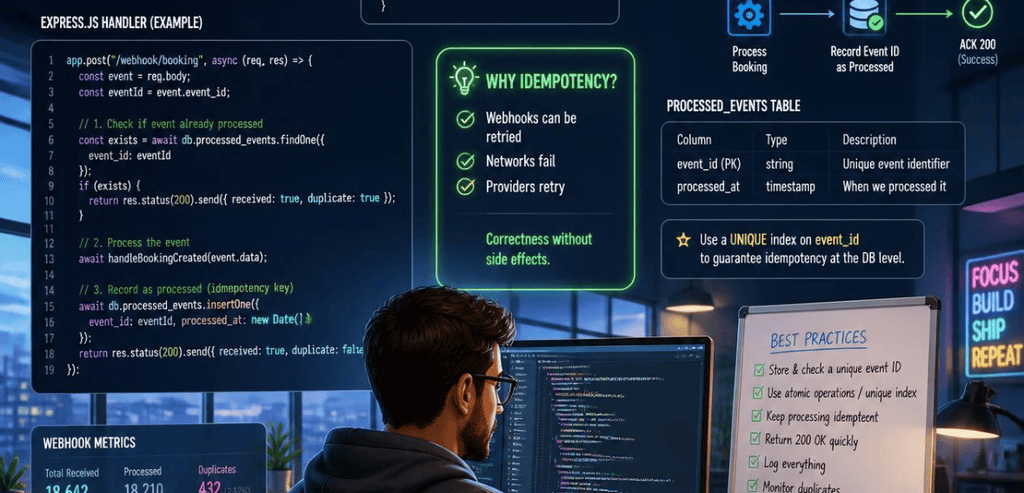
Retries and replays share one dangerous side effect. They send the same event more than once. If your handler is not careful, one booking could charge a card twice or lock two slots.
The answer is idempotency. A handler is idempotent if it processes the same event multiple times and yields the same result each time. If you send booking confirmed ten times, the customer is charged once.
This can be accomplished reliably with idempotency keys. In most cases, booking systems include a timestamp or unique event ID in the booking payload. Prior to actually doing anything in the handler, it claims this ID in the database within a transaction. A unique constraint on a database is more effective than a check in memory, as two events can essentially happen at the same time. If the ID is already present, we skip that work and return a successful response. This one pattern allows us to do aggressive retries, which is a good thing.
Choosing Webhook Infrastructure for Booking Workflows
Building all of this yourself is real engineering. Backoff curves, jitter, dead letter queues, replay tooling, observability dashboards, idempotent delivery. You have to build it and then maintain it alongside your actual product. Many teams decide to buy the reliability layer instead. Here is how the leading options compare for booking-heavy workloads.
Hookdeck
Hookdeck specializes in inbound webhooks with a focus on event orchestration and receipt. It incorporates configurable backoff and automatic retries on failures. It groups related failures together for you to view the root cause and provides a bulk retry button for affected events. Hookdeck provides a window of ten seconds for event responses. If this window is passed, an event handler that takes too long is treated as a response timeout, and the event is queued, as opposed to blocking the pipeline. Hookdeck is a great choice for teams pulling booking events from different vendors due to its deduplication and observability.
Svix
Svix is a product for sending outbound webhooks that is commonly used by B2B SaaS platforms. Features include replay, endpoint analytics, delivery order, and payload transformations. Per-endpoint analytics are useful for booking products with many partners, since you can notify a partner with a failing endpoint before they’ve found out. The core server is open source, so teams can self-host if they want.
Convoy and Hook0
As completely open-source software, Convoy is able to send and receive webhooks for both inbound and outbound communication. This is useful for those needing full data ownership along with an on-prem deployment. However, it should be noted that the implementation of monitoring is also self-configured for this particular solution. Open-source solution Hook0 is smaller in nature and is EU-based for teams who need to keep their data on the continent and is designed for low-volume teams. For a narrower use case than the previous solutions, these solutions may fit that bill.
Build vs. Buy
The correct answer really relies on the scale of the problem. If your system is only handling fewer than 1,000 booking requests each month and can control both the sender and receiver of the requests, a simple queue would suffice with retry logic. Your engineering time will dramatically increase when you make deliverable endpoints available to the customers. You’ll discover that that is often the best time to justify a purchase.
Conclusion
Booking events are promises. A reserved seat, a locked slot, a charged card. When a webhook fails, that promise breaks, and the customer is the one who finds out. A well-designed booking webhook retry system catches those failures automatically with exponential backoff and jitter. A dead letter queue makes sure nothing disappears. And detailed replay logs give you the power to recover cleanly after any outage or bug.
Wrap all of it in idempotent handlers, and retries stop being a risk. They become a safety net. Whether you build this layer or buy it from a platform like Hookdeck or Svix, the goal is the same. Every booking event should arrive, exactly once, no matter what breaks along the way.
Frequently Asked Questions
What is a booking webhook retry?
It is an automatic re-attempt to deliver a booking event after the first try fails. If your endpoint times out or returns an error, the sending system waits and tries again, usually with a growing delay between attempts. This prevents a temporary network hiccup from silently losing a reservation.
How many times should a booking webhook retry before giving up?
There is no universal number, but most systems attempt delivery five to ten times over about three days. After the final attempt, the event moves to a dead letter queue instead of vanishing. From there, you can inspect it and replay it once the underlying issue is resolved.
Why do I need idempotent handlers for booking events?
Because retries and replays both re-send the same event. Without idempotency, a single confirmation could charge a customer twice or double-book a slot. Using the booking ID or event ID as an idempotency key ensures the same event only ever produces one result.
What is the difference between a retry and a replay log?
A retry is the automatic re-attempt that happens the moment a delivery fails. A replay is a deliberate re-send that you trigger later, and the replay log is the stored history of every event and attempt that makes that possible. Retries react in real time, while replays help you recover after a fix.